Showing posts with label Magnetic Letters. Show all posts

Monday

Reading Longer Words?


Does your child guess at longer words? Today I'll show you how to help your child read longer words.
Watch this short video.


It is helpful to break a word into smaller parts. Phonics rules can be used and seen. The rules won't always work, but the word attempt will be close. A child who is good at guessing words will be able to try and read the word again changing the necessary sounds slightly to come up with the right word.

You can write a word with spaces between the word parts on paper, on a magna doodle, or on a white board.


You can use magnetic letters to show spaces between word parts.


You can finger frame to read one word part at a time.


Click this link to find some helpful phonics rules.
Click this link to find out what to expect from a beginning reader.

I usually kept an erasable whiteboard, magna doodle, notebook, or magnetic letters handy when my children were reading a book to me. I think learning to break words apart at sound or syllable level, using phonics rules, and knowing to slightly change vowel sounds or leave some letters silent is the best thing I taught my kids.

Another important thing I taught my children is to stop when what they read didn't sound right or make sense.
I'd let them finish a sentence and hope they would catch it themselves. If they didn't stop, I'd ask if it sounded right. Sometimes I'd repeat what they read and ask which part didn't sound right. We might look at the word and take that word apart. Check out this link for more infomation about how this is done.

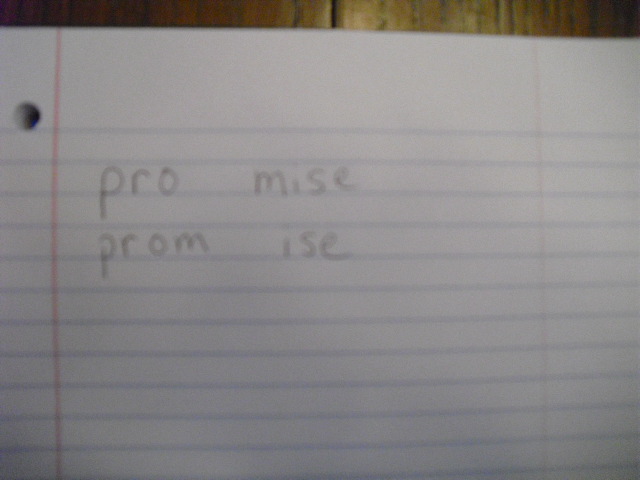
Here's a video showing how to take the word promise apart while reading Just a Daydream.


Phonics Pathways has 26 pages to practice reading words taken apart at the syllable level.
Lessons from this book have helped a fourth grader I'm currently tutoring.


Share/Bookmark

Use Magnetic Letters to Teach Decoding Words Before Reading a Book


You can select a few words from a book your child is about to read and practice sounding out these words before reading the book. This strategy can be used with children who tend to guess at words using meaning and picture clues. My daughter was this type of reader. She did great with beginning readers, but she fell behind her twin brother as books included more words and less picture clues.
Magnetic letters or writing words with a space between sounds can be used to help your child make and blend the sounds in a word.  Your child will be ready to read the words in a book instead of just guess at a word. Readers need to combine many skills and thought processes to be effective readers. A reader who is guessing at words shows he or she is thinking about the story and wants the story to make sense. This is a good thing, but these readers need to be taught to connect letters to sounds when reading. Some readers are great at sounding out words, but they don't think about what they are reading.

Here is a picture of a book with words to sound out from a phonics reading series from Starfall.


Here's a video of some words I chose to sound out before reading Peg the Hen.


Here's a video of my son reading Peg the Hen. Find a free animated version of this story here.


Monkey See, Monkey Do is a Hello Reader from Scholastic. I highly recommend Hello Readers from Scholastic for beginning readers. The following video from shows a few words I would choose to have a child practice sounding out before reading Monkey See, Monkey Do. If a child looks at you to check if he or she read a word correctly, direct the child to the word to see if it was read correctly. This will teach a child to look at letters and letter combinations when reading. If a word didn't make sense, have a child combine looking at the letters and thinking about the story or picture.

Here's a video of sounding out a few words from Monkey See, Monkey Do.


Give this a try with a few words from a book your child is about to read. A little practice will go a long way. Make sure to talk about the story and pictures. What is happening? What might happen next? Find ways to connect your child to stories.
How would your child feel? What would your child do?  Did the story remind your child of something he or she has seen or done? Ask questions and encourage talking before, during, and after a book.


Share/Bookmark

Teach Blends with Magnetic Letters


Blends are tricky for some beginning readers. You can teach blending the letter sounds quickly together with magnetic letters.
When practicing blends I suggest teaching a few at a time with similar sounds.

L Family - cl, sl, fl, pl, bl, gl
R Family - br, cr, dr, fr, pr, tr, gr
Starting with S - sl, st, sp, sn, sc, sw, sk, sm
Starting with T - tr, tw
Starting with C - cl, cr
Starting with F - fl, fr
Starting with B - bl, br
Starting with P - pl, pr
Starting with G - gl, gr
Three Letter Blends - scr, spr, str, spl

Here's a video showing how I teach blends with a beginning reader.


Practicing blends can be fun. It will help your beginning reader a ton. Try a few a day. Let your child think of some words with different blends. Practice making words with short vowels, long vowels, and vowel sound phonograms (ee, ay, ai, ow, ou, oy, oi, aw, au, ew, ui, oo, ea, ar, er, ir, ur, or, oa, ey, ei, ie, igh, eigh, oe, ough, and eu)
Share/Bookmark

Tuesday

Teach CVC Phonics Rule with Short u Words


Practice making the short u sound with a child. Make sure the child is able to make the correct sound. The C stands for consonant and the V stands for vowel. Explain which is which to a child.
The CVC rule gives a new reader a clue to use a short vowel sound. I explain it this way. The vowel is all alone in the middle. The vowel is shy and makes a short sound instead of shouting his own name.

There are exceptions, but they usually follow a spelling pattern. (find, grind, old, cold, sold, told, wild, child, mild) I've found that vowels alone in the middle of consonants usually make a long sound next to a blend or two consonants together. These seem to be the rule breakers.


Here's a video of me teaching how to blend the sounds and read the words using magnetic letters.


Starfall has Gus the Duck and a word making game you may want to use to practice the short u sound.
Share/Bookmark

Monday

Teach Phonics Rules with Magnetic Letters: A Vowel at the End of a Word or Syllable Usually Makes a Long Sound

You can teach phonics rules for words before a child can write letters. Magnetic letters make this possible.

Some work needs to be done with learning letter sounds first. You may be able to teach unknown letter sounds while working with magnetic letters.

The word no is a good first word to teach. The n and o sounds can be stretched out. You can teach the phonics rule: A vowel at the end of a word usually makes a long sound by teaching the words no, so, and go.
Here's a video teaching the words nogo, and so.


Continue to teach a vowel at the end of a word usually has a long sound with the words me, he, we, and she. Be sure to teach the sh diagraph. I'd start with the o and e words first when teaching this rule.

Advanced learners will want to know the long u sound is usually spelled with o or oo (to, do, too), the long a sound is usually spelled ay (day, way, play), and the long i sound is usually spelled with a y (my, try, shy).

This rule works if a vowel is at the end of a syllable. Knowing this rule helps early readers decode words. Here's a video showing how to use this rule when trying to sound out a more than one syllable word.

Share/Bookmark

Wednesday

Two Simple Phonics Rules to Teach a Child When to Use a Short or Long Vowel Sound


Generally when a vowel is at the end of a word or syllable the vowel will have a long sound, and when a vowel is alone between two consonants the vowel will have a short vowel sound. I like to say a vowel is a brave vowel at the end and will say its own name, and when a vowel is hiding between two consonants it is shy and says a short sound. This can be used with the two vowels together rule too. I say when a vowel has a friend it is brave too. The first vowel says its own name.
Here's a video demonstration I created using magnetic letters showing two simple phonics rules.

Share/Bookmark

Tuesday

Teaching Short Vowel Sounds with Video Demonstrations


Short vowel sounds are often very hard for children to learn. It is easy to confuse one sound with another.
1. One way for a child to hear the difference between short vowel sounds is to replace short vowel sounds for a vowel sound in a child's name. Here's a video showing how this is done.


2. Sometimes I play a game with hearing and saying short vowel sounds.


3. I like to show a child how changing a vowel sound can change a three letter word into a completely new word.


Share/Bookmark

Monday

Teach Blending Sounds to Read Words


A child must learn to blend sounds in words to be able to read a word. Some letter sounds can be stretched and are called continuous sounds. Words with these sounds in the beginning are easiest for most children to read. Some letter sounds can only be made for an instant and are called stop sounds. These sounds make blending the sounds together in a word more difficult. It is best to use these sounds at the end of a word when teaching a child to blend sounds together in words.
Examples:
mom - (mmmm-oooo-mm) A reader can stretch out the sounds of m and o until he or she is ready to make the next sound.

dad - (d - aaaaad) A reader may have a more difficult time reading a word with a stop sound at the beginning of a word. There may be a long pause until he or she makes the next sound making it more difficult for the brain to hear the word.

Try out this short list of words. Teach a beginning reader to hold the sound of each letter until the next letter sound is made. You can write these words or use magnetic letters.
sun, fun, run, ran, no, not, fog, frog, ant, man, rat, ran, fan, sit, sat, mat, wet, let, fat, fast
Here's a video of me demonstrating blending.


I taught my daughter to blend sounds with Phonics Pathways: Clear Steps to Easy Reading and Perfect Spelling and Phonics Pathways: Simple Exercises to Improve Reading Fluency.
Share/Bookmark

Thursday

Teach Consonant Blends

Yesterday I helped a student I tutor practice reading words with beginning consonant blends from books before reading. Blends can be tricky for some early readers. Many children like to stop after the first sound in a word. This stopping after the first sound can be a result of too much word family learning. Blending more than one sound without pausing helps a reader hear a word better. Have you heard of body-coda blending?

A reader can learn to see and blend consonant blends together without pausing.

Reading consonant blends quickly together before attempting the rest of a word can be taught by covering up other parts of a word in a book to only show the blend, separating the blend when writing a word, or using magnetic letters to separate the blend.


The books I used to teach and practice consonant blends in these pictures came from a ten book series written by Nora Gaydos. I love all her books! I used the stories: Drips and Spills and Hop, Frog, Hop from the Playful Pals Level 1 Phonics Reader Set.

You can find more information I share about teaching reading on my Parent and Child Reading Assistance Website.  


Share/Bookmark

Wednesday

Practice Stretching Sounds to Read Words

Currently I'm tutoring a student with reading once a week. Here is an activity we did together today. The videos show me using magnetic letters. My student's mom chose to use the book page without magnetic letters to practice stretching and blending sounds to read words from p.59 in Phonics Pathways: Clear Steps to Easy Reading and Perfect Spelling at home. We'll continue to use magnetic letters during tutoring sessions. This book is a great resource for easy quick reading practice. I used Phonics Pathways to teach my daughter to stretch sounds and read words.


Share/Bookmark

Saturday

Magnetic Letters Can Be Organized And Used To Teach Reading


I've made posts describing ways to use magnetic letters when teaching a child to read.
Magnetic letters are powerful tools!
Many teachers and parents find keeping magnetic letters organized difficult. Do you?
Here's a simple way to keep magnetic letters organized! Find a 24 compartment box in the hardware, automotive, craft, or fishing tackle section of a store. I found this one in the fishing tackle section of a sporting goods store. I've also found some for under five dollars in the automotive section of Walmart.

File folder labels work great to label compartments. I use red and blue markers, because I use color coded magnetic letters. Any color of magnetic letters will work though. Since there are 26 letters and only 24 compartments, the letters w and x and y and z are combined in the last two compartments.

This picture shows a set of durable foam magnetic letters with a layer of magnet firmly attached to the back. Wouldn't you love to have letters organized like this for easy access?

The letters w and x, and y and z share.


The next pictures show a few ways to play with words. Letters can be used on the floor, table, or an upright magnetic surface.


So what are you waiting for? Organize some magnetic letters and get using them more often!

Magnetic letters are fun and effective tools to teach reading.


Share/Bookmark

Thursday

Magnetic Letters Can Help a Child Learn to Read and Spell Early


A child can read and spell simple words with magnetic letters . I gave my own children access to magnetic letters before they could write letters. We had so much fun, and they felt so smart.

Start slow with fun words. We were able to connect sounds to letters. It is important for children to hear and make sounds for letters and groups of letters. It felt more like play than teaching and learning. We didn't have to use terms like short vowel and long vowel. My children started to see patterns of the English language in a natural way.

no, go
mom, dad
me, he, she
dog, cat
moo, boo
moo, moon
boo, boom

Play with these words. Model making the sounds for the letters as you make words. Have the child make the sounds for letters as he/she makes words.
After a child knows these words well. Try mixing up the letters for two or three words and have only those letters available on a table, floor, or magnetic surface. Example: n, g, o, o, e, m  Ask the child to make the words: no, go, and me.  Another example: n, g, d, o, o, o, g  Ask the child to make the words: no, go, and dog.

When working with a very young child explain rules only if the child asks. This allows children to discover patterns for themselves. If the child starts to ask he/she is ready for the information you will give.

Here are some of the rules and patterns a child may learn from these words:
A vowel at the end of a word will make a long sound or say its own name.
A vowel trapped between two consonants will make a special short sound.
Sometimes two letters work together to make a new sound. (sh and oo)


Share/Bookmark