Monday

Blend Sounds Using Body-Coda Instead of Onset-Rime


Many people teach beginning readers word families.This is also called onset-rime. The onsets are the beginning consonant sounds, and the rimes are the ends of words. The theory is that children will be able to read words with the same spellings or rhyme at the end.
The problem some readers face with onset-rime blending is the distortion that occurs with stop sound consonants. Vowel sounds are all continuous sounds. This means that when you stretch or hold the sound it stays the same. Stop sounds do not stay the same. There is an extra vowel sound at the end.

Here's a video of me demonstrating continuous sounds and stop sounds.


If a child reads through to the vowel, there will not be a distorted extra sound in a word when reading or listening to someone else separate a word at the onset. Body-coda blending eliminates distortion in a word, because the pause always happens after a continuous vowel sound.
Here's a great article written by Bruce Murray author of The Reading Genie that describes the benefits of teaching a child to use body-coda when blending.

The colored letters are stop sounds.
a b c d e f g h i j k l m n o p q r s t u v w x y z

Here's a video explaining how stop sounds can make reading difficult.


I'll show some ways to use body-coda blending in upcoming posts.
You will find ways to separate words with your voice to improve phonological awareness.
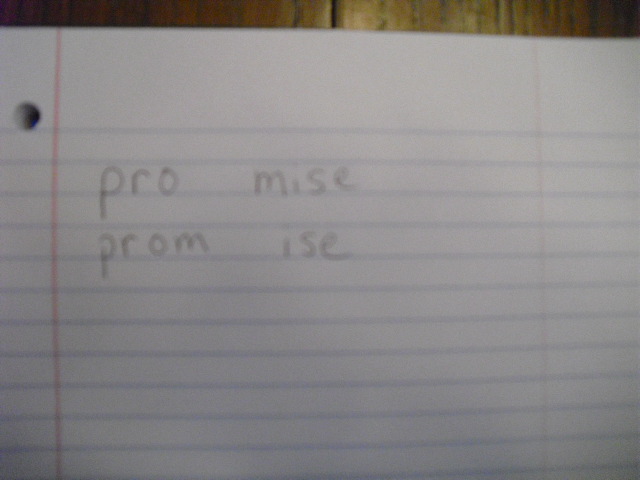
I'm starting a new series of posts dedicated to pre-teaching words with magnetic letters before a child reads a beginning reader book. If you don't have magnetic letters, you can write the words with a space between the places I show to teach a child to pause while sounding out a word.
Share/Bookmark

Friday

Teach a Child to Sound Out Sight Words that Don't Follow Phonics Rules


I've shared some sight word flashcards with phonics rules on the back with directions to print and cut here. You will find all the posts I've shared on this blog related to these flashcards here.
I prefer to call these words high frequency words. Teaching a child to read words by shape and sight caused problems for my daughter and students I've tutored with reading. A human brain is limited in the number of words it can memorize and recall. I've struggled with the idea of teaching sight words. The Reading Genie's explanation of how children learn to decode words and how words eventually become sight words makes sense to me.

"Contrary to past beliefs, sight-word learning does not depend on rote association.  Children learn sight words in just a few quality encounters.  Quality encounters connect letters in a spelling to phonemes in the pronunciation, usually by sounding out and blending.  In other words, we typically learn sight words through careful decoding.  Though decoding demands great attention in young readers, it sets up reliable access routes to retrieve the word.  Once the access route is established, the tools to build it (correspondence rules) drop out.  The spelling becomes a meaningful symbol of spoken word (i.e., it "looks like" the word).  Learning to decode dramatically reduces the number of trials to sight recognition from an average of 35 trials to an average of 4 trials." Source: The Reading Genie: Overview: How Children Learn to Read Words

If children are asked to make the sounds they know in a sight word that doesn't follow rules, then they are learning to sound out and read the word. We can tell a child the part that is silent or makes a different sound. We can then help a child sound out words with sounds the child knows and the sounds given to him or her. The Reading Genie has shared that children who learn to decode or sound out sight words learn to recognize the word quicker than a child who learns a word by sight alone. It helps to teach words with similar sounds, patterns, or silent letters together.

Have you heard of the schwa sound? All the words in this picture have the schwa sound. The schwa sound makes the short u sound. All vowels are known to make this sound. Teach this to your beginning reader. You will find a ton of words with the vowel making the schwa sound.


I have read research that says trying to recall a word by memory uses a different part of the brain than matching letters to sounds. Reading is hard enough for beginners. Now imagine a child's brain having to constantly switch gears. Beginning readers will sound choppy at times while they sound out words. It takes patience to give a child time to go through this process.

A few words will be learned by sight similar to how a child can recognize McDonalds before he or she can sound out the word.

We don't expect our children to walk before they crawl. Teaching sight words from memory is like teaching multipication facts without teaching the math behind the answers. I worry when I see so many people advocating teaching children to memorize sight words. It had a negative impact on my daughter's reading. As soon as I showed her to start sounding out words her reading improved dramatically.

Knowing some sight words is like training wheels for reading. I don't think there is any harm in teaching some sight words to give a child a way to read some beginning reader books. As a child learns more about phonics, blending, and matching letters to sounds he or she will be reading without training wheels.

Find more information I've written for parents teaching their children to read on my profile page at Squidoo. Look for the list of lenses I've written.

Share/Bookmark

Wednesday

Stylish Blogger Award


Katie Smith from First is a Fairytale gave me the Stylish blogger Award. I'm honored. I love Katie's blog. I hope you take a look. There's also a link to her blog and some of my other favorite blogs in my sidebar. You can check out the latest posts of my favorite blogs in my sidebar anytime. I should do some updating. If you have a literacy related blog and would like me to add it to my blog list, let me know in a comment.
Here are the rules for receiving this award:
1. Thank and link back to the person who awarded you this award

2. Share 7 things about yourself

3. Award 15 recently discovered great bloggers

4. Contact these bloggers and tell them about the award
Seven things about me:
1. I taught as a substitute teacher for four years. (Finding a teaching job in my area is competitive.)
2. I taught with School District #2 as a second grade teacher, third grade teacher, and Reading Recovery teacher for four years.
3. I chose to stay home with my three children in 2003. Infant twins, a two year old, a full time teaching job, and a traveling husband wasn't a combination that offered sanity.
4. I loved staying home with my children and feel fortunate that we were able to make it work.
5. I began researching best practices to teach reading and found my passion.
6. I currently volunteer as a reading tutor to two students at my children's school, tutor one child from my home, consult with one parent from my home, write this blog, and write at Squidoo.
7. I haven't had one yet, but I'm preparing to have in home Beginning Reading Help parties. A person hosts it at their home, invites their friends, and gets a percentage of the sales for their own purchases. I sell products I've listed on the link at the top of this blog. I'm working on making some of my own materials and writing a how to teach a child to read book.


Blogs:


Ready Set Read 2 Me
Vote in a Reader's Choice Award for this blog.
It takes less than a minute.
Please help out my friend.
She's in second place.
Your vote matters!
Thanks!
http://familyinternet.about.com/b/2011/02/11/2011-readers-choice-awards-vote-for-best-live-and-learn-parenting-blog.htm

Letter Soup

Teach with Picture Books

Wow! That's a lot of blogs. I'm off to contact these bloggers. I hope my readers take a peek and maybe follow a few new blogs today. Did you find a new blog to love? Let us know in a comment!

Share/Bookmark

Monday

Share Read The Chick and the Duckling


Shared reading allows a child who can't read words yet to pretend read a familiar book. If your child can't read yet, you should read this book to your child a number of times before asking a child to share read this story.
If your child is beginning to read, you can have a child practice reading words. You can get your child ready to read words in this book by using magnetic letters. One way to help a child learn words is to present the words on a board, mix them up, and have a child put the words back together making the sounds as the letters are put in place.


These are the words a child will be reading for part of the chick. (said, cried, me, to, the, not) Present the words on a magnetic letter board, sound them out, have your child mix them up, and put the words back together.


Did your child have success putting these words back together? Do you think your child is ready to read these words in a book? Then you can give your child the part of the chick without reading the story to your child a few times first. You'll want to show the word chick. Talk about quotation marks. Tell your child he or she has the part of the chick, and you will read the rest.


Here's a video of me share reading The Chick and the Duckling with my daughter.

Share/Bookmark

Friday

Practice High Frequency Words with The Berenstain Bears and The Spooky Old Tree


Have you printed the high frequency word flashcards I shared. You will find a link to print these and the directions to cut them here. Find ways I've shared to practice and teach with them here.
The Berenstain Bears and The Spooky Old Tree is a fun beginning reader book. It is still one of my children's favorite books. They all had to read it when they saw our copy on the table today. I think it brings back happy memories of us snuggled together sharing the reading of this book.


Have you heard of shared reading?

Together Time 4 Families wrote a great post describing shared reading with links to some good books for shared reading. The post is titled, The Importance of Shared Reading With Young Children . Here's a section of her post that will help you understand more about shared reading and why you might want to try it. Click on the highlighted link to read the entire post and find recommended books.

"There are a variety of types of books you read with your child such as fairy tales, chapter books, nursery rhymes, predictable books, picture books, songs and poems to name a few. But there is a particular type of book and type of reading that provide special benefits. Shared reading using predictable books offer benefits for facilitating the reading and writing foundations for young children.
Shared reading is a type of reading interaction between parent/adult/child. The book is read many times (you know, it is that book your child insists you read over and over). You do the reading and soon your child joins in and shares reading with you.
Predictable books promote reading and writing foundations because these books have
repeated patterns
refrains
pictures
rhymes
Because of these traits, children internalize the book that leads to "pretend-reading".
"Shared reading of predictable books allows children to experience this pretend reading. From this pretend reading, they learn what reading is, and they develop the confidence that they will be able to do it. They will also develop print concepts and begin to understand how letters, sounds, and words work"
states P.M. Cunningham.

Cunningham gives three criteria when choosing predictable books.

The book must be very predictable.It allows children to be able to "pretend read" after several readings promoting confidence. Choose a book that has minimal print and sentence patterns that are very repetitive and pictures that support the sentence patterns.


The book must be appealing to the child/children. It should be a book that children want you to read over and over."


 Click here for the rest of this post from Together Time 4 Families.

The Berenstain Bears and The Spooky Old Tree is a perfect book to share read. My kids just started share reading this book after I read it too them a number of times. I didn't even think about what we were doing or what the educational community called it. It just happened.


Sharing the reading of the book will be different each time. Here are some videos to watch to get some ideas. Each of these videos show a little different take on how to share read a book. The last video is a little strange but offers great information.


 If you want your child learning some high frequency words, I suggest practicing some flashcards before either reading the book to your child and pointing under the words or share reading the book. 


Share read The Spooky Old Tree a number of times. It won't be long and your child will be reading this book on his or her own. Every time you read this book your child is seeing high frequency words. The high frequency words your child will encounter in this book are: little, one, with, a, do, go, that, and, will, how, out, up, down, at.

You may want to make a few of your own flashcards for other high frequency words found in The Berenstain Bears and The Spooky Old Tree.

Have you noticed I've been posting about flashcards every Friday and magnetic letters every Monday? It's my way of making sure I post at least two times per week. You'll find more posts when I'm inspired and have time. Make sure you are following or subscribed with email if you don't want to miss a post.

FYI - I've been writing lenses at Squidoo lately? Here's a helpful lens I wrote at Squidoo called Reading Starts at Home. You'll find ideas to help your child with reading ages birth to six years old. You will find more lenses on my profile page at Squidoo and on MY BEST TEACHING ADVICE page from this blog.
Share/Bookmark

Wednesday

Teach My Child to Read - Have you thought about a reading tutor?


I tutor children with reading, but I'd rather help parents be a reading tutor to their own child. That's why I write this blog. I've done some writing at Squidoo lately to share information with parents, so they don't have to get a reading tutor for a child.


Parents who know a little about teaching reading can make a huge impact. I think I've shared some simple ways for you to help your child learn to read in two lenses I wrote at Squidoo.

Teach a Child to Read with Phonics

Reading Starts at Home

Read my lenses at Squidoo. Take some of this information and work with your child throughout the week. It takes patience to teach your own child. I know from experience. The payoff is so worth it!

Best wishes on your reading journey! You CAN be your child's best teacher! Believe! I think I can... I think I can... You can! You did! Come back and share your success in a comment.
Share/Bookmark

Tuesday

Teach a Child to Read and Spell Using Magnetic Letters and Writing a Grocery List

Do you dread taking your children to the grocery store? I've found that my children behave better when they are my helpers. One way to get your children helping is to have them make a grocery list.

You can use your set of magnetic letters to help a child sound out and spell items on a grocery list.

You will be able to teach phonics rules, rule breakers, letter sounds, and special letter combinations. Here's a resource to help you separate sounds in words to help you teach a child to separate sounds needed to spell words. Here's a helpful list of sounds in words and their spellings.


After spelling a word, see if your child can mix up the letters and put the word back together. Encourage your child to make the sounds of letters and letter combinations as he or she puts them in place. Your child can use the magnetic letters to copy the word onto his or her grocery list.

Make your child in charge of finding and checking off items on his or her list. If you have more than one child, you could split up different sections of the grocery store.

This post from Ready Set Read gave me inspiration for today's post.
Share/Bookmark

Monday

Happy Valentine's Day!


Magnetic Letter Monday's post will be published on Tuesday this week. I've had a busy day with my children's class parties etc. I'm only half done writing the post. Look for it tomorrow. I hope you are having a wonderful Valentine's Day.
Please check out previous Magnetic Letter Monday posts until then.

You can check out a great Facebook community I created called We Teach Children to Read. Look for two links posted here just for Valentine's Day. Post some of your own teaching children to read resources and make a comment or two.
Share/Bookmark

Friday

Help a Child Learn High Frequency Words Using Related Phonics Rules


Print and cut the high frequency flashcards I shared in a previous post. Teach and practice some of these words your way or use some of the ways I've shared.
Make some blank cards to teach and practice new words with related phonics rules. You can add a few more words that follow these rules. Learn more about teaching phonics here.

When children are first learning and practicing new words with flashcards, I like to leave all related words next to each other. This way a child begins to see a pattern and learns a rule without having to memorize each rule. This type of practice will get a child's brain to start making a category of words and automatically find the right rule to try when reading new words that fit the category or pattern. This post will focus on three common patterns found in beginning reader books.

Here are pictures of how I like to group some of the flashcards when I teach with them.

The first 3 pictures show consonant and vowel patterns to determine vowel sounds.

CV- Words with this pattern usually have a long vowel sound at the end of a word.
Find more words that follow this rule. You could add the words he, hi, or ho ho ho.


VC - Words with this pattern will usually have a short vowel sound at the beginning of the word.
Can you think of more words for this rule? Look for some in books you read.


CVC - Words with this pattern will usually a short vowel sound in the middle of the word.
Once you start looking, you will find a ton of words that follow this rule. Words ending with ind, old, and ild usually have a long vowel sound. Words with this spelling pattern can be taught as a group.


Here are some other groups of flashcards I will show how to work with soon.


Share/Bookmark

Monday

Reading Longer Words?


Does your child guess at longer words? Today I'll show you how to help your child read longer words.
Watch this short video.


It is helpful to break a word into smaller parts. Phonics rules can be used and seen. The rules won't always work, but the word attempt will be close. A child who is good at guessing words will be able to try and read the word again changing the necessary sounds slightly to come up with the right word.

You can write a word with spaces between the word parts on paper, on a magna doodle, or on a white board.


You can use magnetic letters to show spaces between word parts.


You can finger frame to read one word part at a time.


Click this link to find some helpful phonics rules.
Click this link to find out what to expect from a beginning reader.

I usually kept an erasable whiteboard, magna doodle, notebook, or magnetic letters handy when my children were reading a book to me. I think learning to break words apart at sound or syllable level, using phonics rules, and knowing to slightly change vowel sounds or leave some letters silent is the best thing I taught my kids.

Another important thing I taught my children is to stop when what they read didn't sound right or make sense.
I'd let them finish a sentence and hope they would catch it themselves. If they didn't stop, I'd ask if it sounded right. Sometimes I'd repeat what they read and ask which part didn't sound right. We might look at the word and take that word apart. Check out this link for more infomation about how this is done.

Here's a video showing how to take the word promise apart while reading Just a Daydream.


Phonics Pathways has 26 pages to practice reading words taken apart at the syllable level.
Lessons from this book have helped a fourth grader I'm currently tutoring.


Share/Bookmark

Friday

Practice Reading High Frequency Words with Five Free Online Stories.


Free Online Stories:
Each story has a stop button. You can use the stop button to look for high frequency words a child knows, practice reading together, or let a child reread a page on his or her own.

If a child is making a mistake on more than one in twenty words, the story is not at his or her reading level. You can give support by telling a word, helping a child sound a word out, reading at the same time, or encouraging a child to reread from the beginning of a sentence. It is amazing to see what happens when a child rereads a sentence after figuring out one or two words. The child will then combine his letter to sound knowledge with the flow of the sentence.

Please look for my suggested uses for these stories further down this page.
Special thanks to Reading is Fundamental and Mighty Books for sharing these free children's books online.
The Big Wave


Jungle Eyes


Donkey Jack


If Only I Were


Dinosaur Horn


Are you are using the set of 70 high frequency word flashcards I shared? These stories will give your child an opportunity to practice some words he or she has learned. If you haven't printed the flashcards and want to, visit this link. Find some ways I've shared to introduce, teach, and practice these high frequency words here.

My Suggested Ways to Use These Free Online Stories:
These are only suggestions. Please follow your child's lead. You will know if something is too hard. Learning to read can be fun for a child if we push them a little at a time without frustration.

1. Let the story play all the way through the first time. Let a child enjoy the pictures and story at least once before attempting to teach with it.

2. Play the story and stop on all or just a few pages to search for known words. You could practice sounding out some words too.

3. Play the story. Stop on all or just a few pages and reread the page with your child. Try to imitate the expression of the recorded reader as you point under the words.

4. Play the story. Stop on all or just a few pages and let a child reread the page alone.
Share/Bookmark