Monday

Blend Sounds Using Body-Coda Instead of Onset-Rime


Many people teach beginning readers word families.This is also called onset-rime. The onsets are the beginning consonant sounds, and the rimes are the ends of words. The theory is that children will be able to read words with the same spellings or rhyme at the end.
The problem some readers face with onset-rime blending is the distortion that occurs with stop sound consonants. Vowel sounds are all continuous sounds. This means that when you stretch or hold the sound it stays the same. Stop sounds do not stay the same. There is an extra vowel sound at the end.

Here's a video of me demonstrating continuous sounds and stop sounds.


If a child reads through to the vowel, there will not be a distorted extra sound in a word when reading or listening to someone else separate a word at the onset. Body-coda blending eliminates distortion in a word, because the pause always happens after a continuous vowel sound.
Here's a great article written by Bruce Murray author of The Reading Genie that describes the benefits of teaching a child to use body-coda when blending.

The colored letters are stop sounds.
a b c d e f g h i j k l m n o p q r s t u v w x y z

Here's a video explaining how stop sounds can make reading difficult.



Share/Bookmark

Tuesday

Teach a Child to Read and Spell Using Magnetic Letters and Writing a Grocery List

Do you dread taking your children to the grocery store? I've found that my children behave better when they are my helpers. One way to get your children helping is to have them make a grocery list.

You can use a set of magnetic letters to help a child sound out and spell items on a grocery list.

You will be able to teach phonics rules, rule breakers, letter sounds, and special letter combinations. Here's a resource to help you separate sounds in words to help you teach a child to separate sounds needed to spell words. Here's a helpful list of sounds in words and their spellings.


After spelling a word, see if your child can mix up the letters and put the word back together. Encourage your child to make the sounds of letters and letter combinations as he or she puts them in place. Your child can use the magnetic letters to copy the word onto his or her grocery list.

Make your child in charge of finding and checking off items on his or her list. If you have more than one child, you could split up different sections of the grocery store.

This post from Ready Set Read gave me inspiration for today's post.
Share/Bookmark

Monday

Reading Longer Words?


Does your child guess at longer words? Today I'll show you how to help your child read longer words.
Watch this short video.


It is helpful to break a word into smaller parts. Phonics rules can be used and seen. The rules won't always work, but the word attempt will be close. A child who is good at guessing words will be able to try and read the word again changing the necessary sounds slightly to come up with the right word.

You can write a word with spaces between the word parts on paper, on a magna doodle, or on a white board.


You can use magnetic letters to show spaces between word parts.


You can finger frame to read one word part at a time.


Click this link to find some helpful phonics rules.
Click this link to find out what to expect from a beginning reader.

I usually kept an erasable whiteboard, magna doodle, notebook, or magnetic letters handy when my children were reading a book to me. I think learning to break words apart at sound or syllable level, using phonics rules, and knowing to slightly change vowel sounds or leave some letters silent is the best thing I taught my kids.

Another important thing I taught my children is to stop when what they read didn't sound right or make sense.
I'd let them finish a sentence and hope they would catch it themselves. If they didn't stop, I'd ask if it sounded right. Sometimes I'd repeat what they read and ask which part didn't sound right. We might look at the word and take that word apart. Check out this link for more infomation about how this is done.

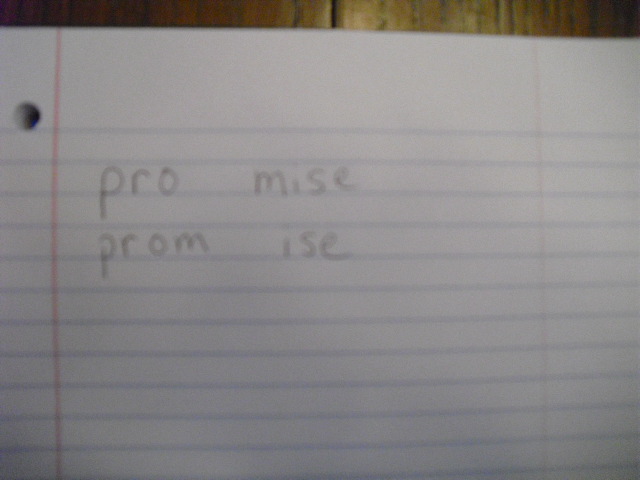
Here's a video showing how to take the word promise apart while reading Just a Daydream.


Phonics Pathways has 26 pages to practice reading words taken apart at the syllable level.
Lessons from this book have helped a fourth grader I'm currently tutoring.


Share/Bookmark