Many reading experts suggest giving an introduction to a book before a child reads. A good introduction will engage the reader and give a purpose for reading. Check out some of these exciting book introductions.
Look for a book you own, make a list for your next library visit, or use the Amazon search box on this site to find books you want to read from video introductions.
Try making your own introductions to other books to build interest and give a purpose for reading.
Print awareness includes understanding the role of punctuation. This story provides a great opportunity to introduce the use of quotation marks.
Before reading this story explain the role of a narrator and characters in a story. Make it simple and say, "The narrator tells us the story, and the characters do and say things in a story. The narrator in the book we are about to watchtells us who is talking. Each character's words are inside the quotation marks. Let's listen to this story and hear what the characters say."
This book has a stop button. Use this button to stop and point out punctuation marks, discuss the story, look at pictures, or practice reading the sound words using phonics knowledge.
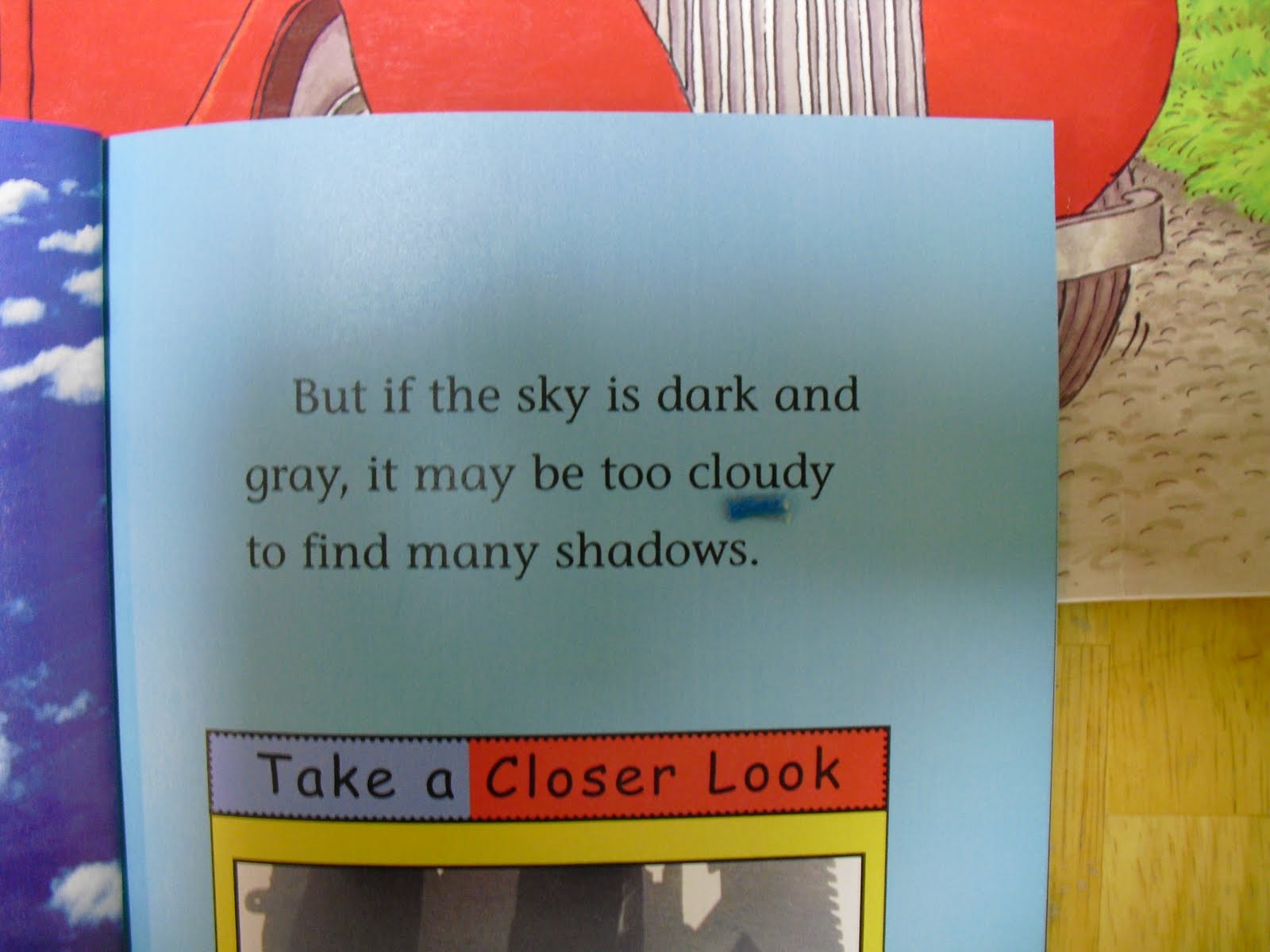
Wikki Stix can be cut and used to underline letter combinations in books you read outloud to a child. Turn any book into a phonics lesson! Books with glossy pages work best. Wikki Stix may leave a little color or rip a little paper if pressed on too hard or left on too long. I suggest you don't use Wikki Stix on library books, but the benefits of this activity may be worth a little damage to your own books.
The next pictures show underlining of "ou" in different books. Introduce the underlined sound.Have a child repeat the underlined sound. Separate the underlined sound when reading the word and have a child do the same with his or her own voice. Beginning readers will learn to identify common letter combinations, make the sounds for common letter combinations, and blend sounds from the beginning to the end of a word. A child will learn to decode words with some support from you and great books you would've read aloud anyway.
(CL - OU - DY)
(M - OU - SE)
(SH - OU - T)
(OU - T)
There are many more letter to sound combinations a beginning reader can learn with this activity. Click here for a useful chart to find more. Try starting slow. Make it fun. Introduce only the most common combinations. More is not better. You want a child to build confidence and start to see combinations in words without an adult pointing them out.
Use Wikki Stix to Teach Common Letter Combinations While Reading
I'll provide a helpful introduction to give to a child before listening to this story. The story has a stop button. Please use the button to stop and talk about the story with a child. Make predictions, talk about feelings, ask what the child would do, etc.
Introduction: "In this story a girl named Joy went to a summer camp for young witches. Do you think you'd like to go to a summer camp and learn to be a witch? Can you think of a spell you would like to learn? (Share a spell you would like to learn. I might share I'd like to be able to snap my fingers and have a clean house.) Things went wrong for Joy when she tried to make a spell to turn herself into a fairy. Let's listen to this story and find out what goes wrong."
After you've tried this, please share how it went with a comment.
Find more stories here.
I'll be adding more introductions and ways to use free online stories. Subscribe to this blog, so you don't miss a post.
Improve Reading Comprehension with Online Stories - The Frog Princess
Wikki stix can be used to make letters and words. Super Wikki Stix or more than one Wikki connected to another can be used to show correct letter formation with printing or cursive. A child can spell simple words and practice making letters.
These Wikki Stix are stuck to a wall in my house. I moved them without leaving any marks on my freshly painted wall. I was a little worried when we put them up, but no marks were left after being on the wall for over a month.
Wikki Stix are a fun activity to keep children entertained. Check out these products and the reviews from some Amazon shoppers. Look for Super Saver Free Shipping! Wikki Stix
Wikki Stix are a great toy! They can also be used a number of ways to help a beginning reader. I'll be making more posts showing creative ways to use Wikki Stix. I have a few Wikki Stix, but I'm buying the Wikki Stix Activity Set, Super Wikki Stix, and the Wikki Stix Big Count Box today. Subscribe to this blog, so you don't miss a post.
Children Can Use Wikki Stix to Make Letters and Words
I tutor a second grader with reading from my home. He has a sister in first grade. I also tutor her at a different time. The siblings are at about the same level. That means the second grader is below the level of an average first grader. My second grade student gets frustrated and has been struggling for 2 years everyday! He is difficult to teach, because he wants to do everything on his own. When I try to show him something, it makes him mad. (I'm thinking he has some issues from this. http://www.reading2008.com/blog )
Yesterday I had a great lesson planned. I started with magnetic letters. I'm trying to teach him to blend the first two letters in a word. He has a habit of making the first sound, pausing, and then trying to read the rest of the word as a chunk. He often mixes up the order of letters.
My student got frustrated and tried to stop me from using the magnetic letters. I couldn't think of how else to teach this skill. He said, "This is why I don't like coming here. You never listen to me." I stopped and listened. He said, "I like writing. Can't I write?"
I taught him some cursive writing in other sessions. I let him write the first two sounds in cursive. He blended the sounds together perfectly. He enjoyed the practice and did well! After he blended the sounds verbally, I held up a magnetic letter for the ending sound of a word. He blended the whole word together! It was the most productive session we've had!
My favorite way to teach correct letter formation is with finger paint! I like D'Nealian or Modern Manuscript printing. The schools in my area use this type of printing. It has a nice flow and makes transitioning to cursive easy for children.
Writing with finger paint is easy, fun, and a little messy. You'll love it! Tape a large piece of freezer paper with the shiny side up to a table or wall. Then glob enough finger paint on the paper to make a thick layered writing surface. Smear the paint and smooth it out. Click here for a video of my son getting his paper ready. Use the index finger of writing hand to write like a pencil. The white of the paper becomes the line you make.
I think teaching correct letter formation is important from the start. My oldest son started writing his name in preschool. He started making his lowercase r from the bottom. He also started his lowercase m and n from the bottom. Even after I taught my son the right way to form the letters, his hand and brain reverted back the way he had practiced.
Grouping letters by where they start and teaching ones that are similar helps teach proper formation quicker. In this video I show forming the letters a, c, d, and g.
Make it productive by only teaching as long as a young child has patience. (3-5 minutes) Give a child a little creative time. Allow mixing more paint, writing more letters, or making designs. I suggest cleaning up after 10 minutes. The paint will start to dry out. Sometimes my children saved the last letters, words, or designs they created.
This is a blog for teaching a child to read. Writing is an important way to increase a child's ability to read. As a child writes a letter, say the sound for a letter and encourage the child to voice the sound while writing a letter.
Once a child has learned to form letters correctly, any natural writing task becomes practice. Extra practice and reteaching can be done with fingerpaint, magna doodles, white boards, or sidewalk chalk. Learning to write can and should be fun.